Structural Drying and Dehumidification in Kalama, WA
Extraction is only half the job, so the crew maps moisture, sets LGR dehumidifiers and air movers, and logs readings until walls, floors and framing reach their dry targets.
(888) 509-1696Start a moisture mapping plan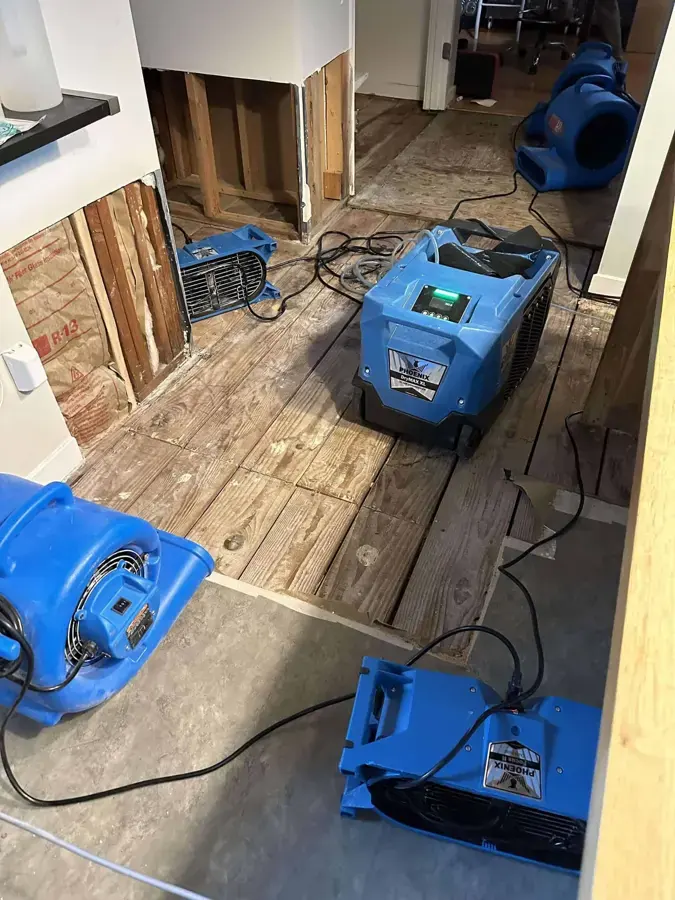
First steps for structural drying and dehumidification in Kalama
Remove standing water
Standing water slows drying, so extraction should come first.
Keep doors and windows closed
Closed rooms let dehumidifiers work efficiently and keep humidity from spreading.
Leave equipment alone
Moving or turning off air movers upsets the airflow plan, so call before changing anything.
Note the humidity
If a room feels clammy after the equipment stops, tell the crew so readings can be rechecked.
How structural drying and dehumidification is handled in Kalama
Water that looks gone is often still inside the building. Framing, subfloors, plaster and concrete hold moisture long after the surface feels dry, and humid air from a wet structure can spread dampness to rooms that were never touched. Structural drying is the controlled process that removes it.
What does structural drying and dehumidification cost in Kalama, WA?
Cost follows the rooms involved and how dense the materials are. One or two rooms run $1,500 to $3,000, several rooms $3,000 to $5,500, and a Class 4 or large loss $5,500 to $12,000.
One or two rooms
- LGR unit and air movers
- Moisture map
- Daily readings
Several rooms
- Several LGR dehumidifiers
- Wall cavities dried
- Psychrometric logs
Class 4 or large loss
- Desiccant dehumidifiers
- Hardwood and concrete drying
- Complete claim file
Ranges are typical, not a quote: the water category, square footage, material class and how fast drying started move the number most. Run the water damage cost calculator for a closer range.
The structural drying and dehumidification process in Kalama
Map the moisture
The tech scans floors, walls and ceilings with meters and a thermal camera, then marks each wet area.
Set the equipment
Air movers and LGR dehumidifiers are placed to match the room size, the materials and the air volume to be dried.
Monitor daily
Readings of materials, temperature and humidity are logged every visit, and units move as the wet areas shrink.
Release the space
Once wet materials match the dry reference, equipment is removed and the final readings are filed with the job record.
Drying in a wet-season climate
From October to March roughly 80 percent of the year's rain falls, and January nights hover just above freezing. Outdoor air in that season is cool and damp, so drying relies on dehumidifiers that work in those conditions, not on opening windows.
That is why LGR dehumidifiers, which keep pulling water from air at low temperatures and high humidity, anchor the drying plan.
Older homes need a tailored plan
Vintage houses from about 1880 to 1920 still stand in town, and older framing, plaster walls and thick trim dry at different rates than newer drywall. Equipment is placed to suit the construction, not a standard layout.
- Moisture map to find every wet area
- Air movers placed to sweep wall bottoms and floors
- Dehumidifiers sized to the air volume
- Daily readings and equipment adjustments
How drying is measured
Technicians take readings in materials and in the air, record temperature and humidity, and compare them with a dry reference taken in an unaffected room. Equipment comes out only when wet materials match it.
Thermal imaging helps find damp spots behind finished surfaces, and moisture meters confirm the numbers. Both guard against closing up a wall that still holds water.
For rough durations, the drying time estimator is a starting point, and the water extraction stage should come first.
Class 4 materials take longer
Hardwood, plaster and concrete hold water deeply and need desiccant dehumidifiers and patience. Rushing them risks cupping, cracking and hidden dampness.
Structural drying and dehumidification across Kalama and nearby communities
Dispatch runs 24/7 for Kalama, WA, day or night.
Drying plans are set up in newer houses and older homes across ZIP 98625, from the vintage streets near downtown to the hillside neighborhoods and from Columbia Terrace Estates to the Cloverdale Road corridor.
The same service nearby: structural drying and dehumidification in Longview, Kelso, Woodland.
Structural Drying and Dehumidification questions in Kalama, WA
Water still spreading?
Water gone but the building still damp? Describe it and the crew sets a drying plan.
(888) 509-1696 Describe the damp roomsWhy does a house still feel damp after the water is gone?
Moisture stays in framing, subfloors and plaster long after the surface feels dry, and humid air carries it to other rooms. Dehumidifiers pull that moisture out of both materials and air.
How long does structural drying take?
Most jobs run several days, and dense materials such as hardwood or concrete take longer. Daily readings, not the calendar, decide when equipment can leave, and the drying time estimator offers a rough idea.
Why not just open windows and use fans?
In the cool, damp air of a wet season, outside air often holds more moisture than a dehumidified room. Closed rooms with dehumidifiers dry faster and more predictably.
What is an LGR dehumidifier?
LGR stands for low grain refrigerant. These units keep removing moisture when air is cool and humid, which suits winter drying better than a standard household dehumidifier.
Can hardwood floors be saved after a leak?
Often yes when drying starts early, using mats or panels that pull water from beneath the boards. Boards that have cupped badly or soaked for a long time may need replacement.
Does the equipment make the house noisy and hot?
Dehumidifiers and air movers run continuously and add warmth and noise, which is a normal part of drying. Equipment is placed to avoid blocking exits and is removed as soon as readings allow.
Dry the framing, not only the surface
Hidden moisture in framing and subfloors causes trouble long after a cleanup looks finished. Tell the crew what happened and the drying plan starts with a moisture map.
(888) 509-1696Book a moisture map