Crawl Space Water Removal in Kalama, WA
Water that pools under a floor stays out of sight while it soaks joists and insulation, so the crew pumps it out and dries the framing in place.
(888) 509-1696Book a crawl space inspection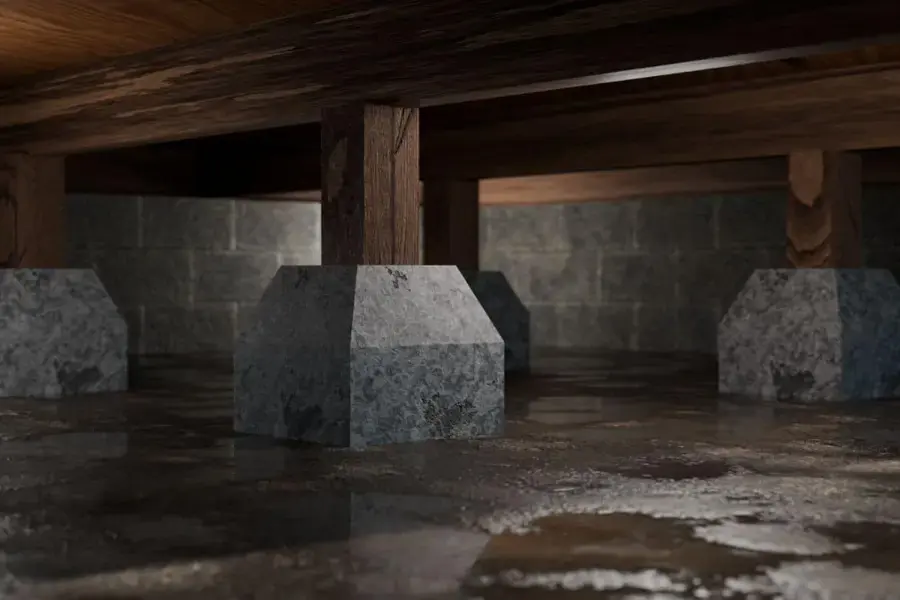
First steps for crawl space water removal in Kalama
Find the source
Look for a running pipe, a full drain or runoff at the foundation, and shut off the supply valve if a pipe is leaking.
Stay out of deep water
Standing water near wiring or sewage is a hazard, so wait for the crew rather than entering a flooded space.
Note what you see
Photograph the water level, wet insulation and any visible leak, and write down when the problem started.
Watch the floor
A musty smell, cold floors or soft spots upstairs show moisture is spreading, so mention them at the walkthrough.
How crawl space water removal is handled in Kalama
A crawl space hides water well. A leaking supply pipe, a clogged drain or runoff from a wet winter can sit under the floor for weeks, wetting joists, insulation and the underside of the subfloor while nothing shows upstairs. A musty smell or a cold, springy floor is often the first hint.
What does crawl space water removal cost in Kalama, WA?
Crawl space jobs depend on depth, insulation and water type. Pump-out and drying runs $1,000 to $2,500, removal of insulation and barrier $2,500 to $5,000, and flood or Category 3 water $5,000 to $10,000.
Pump-out and drying
- Water pumped from the space
- Dehumidifier and air movers set
- Framing moisture checked
Insulation and barrier out
- Soaked insulation bagged and hauled
- Vapor barrier taken out
- Framing dried where it stands
Category 3 or flood water
- Sewage or flood water removed
- Framing and soil treated
- Photo and reading records kept
Ranges are typical, not a quote: the water category, square footage, material class and how fast drying started move the number most. Run the water damage cost calculator for a closer range.
The crawl space water removal process in Kalama
Walk the space
The tech finds where the water enters, measures depth and takes moisture readings on joists, sill plates and the subfloor underside.
Clear the water
A submersible pump clears standing water, and a wet vacuum chases the pooled areas.
Strip wet material
Soaked insulation and torn vapor barrier are bagged and carried out so they stop holding water against framing.
Dry and verify
Air movers and dehumidifiers run until readings at marked framing points match the dry reference.
Where the water comes from
In this part of Cowlitz County, about 80 percent of the year's rain falls from October to March, so drainage problems tend to surface in winter. Gutters that dump at the foundation, sloping ground and a failed drain all send water under a house.
- Gutters and downspouts that release water beside the foundation
- Sloping ground that sends runoff toward the house
- A leaking supply pipe or a failed drain below the floor
- Groundwater that rises after long wet spells
What removal involves
The crew first finds the source and checks depth, then sets a submersible pump to clear standing water. Wet insulation is bagged and carried out, and the vapor barrier is pulled back or removed where it traps moisture against the soil.
Where the space is tight, crews work from the access panel with extension tools and portable pumps, and the plan accounts for limited room to move equipment. Photos taken from inside the space become part of the claim file.
Joists, the underside of the subfloor and the sill area are dried with air movers and dehumidifiers placed for the space. Readings at set points show when the framing has dried, and the crawl space risk check helps owners judge how exposed a house is.
When the water is not clean
Sewage from a broken drain or flood water carries pathogens, so that job adds containment, protective gear and treatment of framing and soil. The sewage backup cleanup steps apply whenever the water is not clean.
Fix the source too
Drying a crawl space does not help for long if gutters, grading or a leaking pipe keep feeding it, so the source repair belongs on the same plan.
Crawl space water removal across Kalama and nearby communities
Dispatch runs 24/7 for Kalama, WA, day or night.
Crews reach the Spencer Creek Road hillsides, where sloping ground sends runoff toward foundations, along with Green Mountain Road, Cameo Drive, Columbia Terrace Estates and China Gardens in ZIP 98625 of Cowlitz County.
The same service nearby: crawl space water removal in Longview, Kelso, Woodland.
Crawl Space Water Removal questions in Kalama, WA
Water still spreading?
Water under the floor of your home? Tell the crew what you found.
(888) 509-1696 Describe the space belowHow does water get into a crawl space?
Common routes are gutters that discharge beside the foundation, sloping ground, a leaking supply pipe, a failed drain and groundwater during long wet spells. Finding the route decides what gets repaired.
Is crawl space water dangerous to enter?
It can be. Standing water may sit near wiring, and sewage or flood water carries contamination. Entry should wait until the power is handled and the crew has assessed what is in the water.
Does the insulation have to come out?
Wet fiberglass insulation holds water against the floor above and rarely dries well in place, so it is usually bagged and removed. Dry sections away from the wet area can sometimes stay.
How long does a crawl space take to dry?
Time depends on how much framing is wet and how much air can move through the space. Readings at marked points on the joists decide when the equipment can come out.
Should a vapor barrier be replaced?
A barrier that is torn, soaked or trapping moisture is removed, and replacement is a rebuild decision made after drying. The crew documents its condition for the claim file.
Can the risk check help before a problem starts?
The crawl space risk check is a quick way to see how exposed a space may be, and a walkthrough then confirms it in person.
Dry out the space below your floor
Hidden water keeps working on framing and insulation while the rooms above look fine. Describe what you see and the crew sets a plan for the space underneath.
(888) 509-1696Schedule the pump-out