Drying Time Estimator for Longview, WA
Estimate how long a Longview water loss takes to dry. The window depends on the class of loss, the water source, the season and how soon drying started.
(888) 509-1696Longview drying questions, 24/7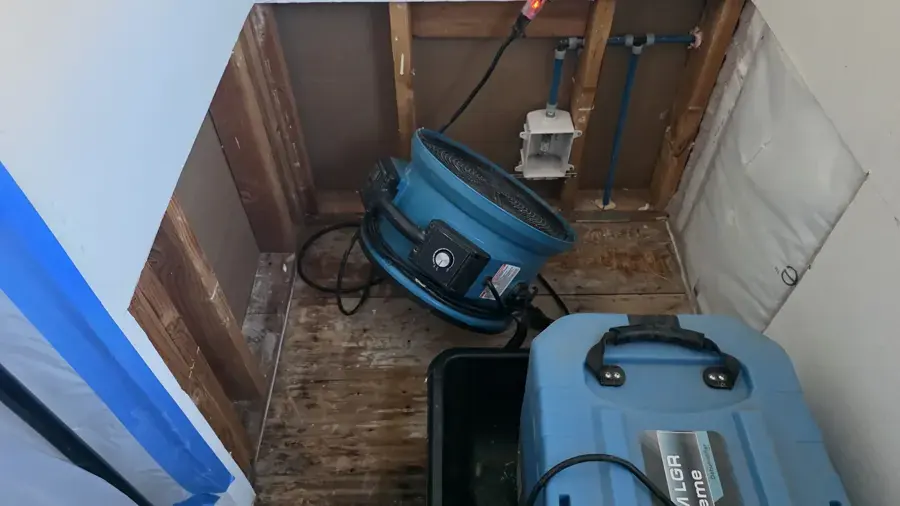
Four questions, one drying window
Pick the answers closest to your loss to see a typical number of drying days for a Longview home.
Typical drying time
0 days
Pick your answers to see the result.
Equipment leaves on readings, not on a schedule: materials must reach 2 to 4 points of a dry reference.
Call the Longview drying teamDrying time for water damage in Longview, WA
Class 1 through 4
The class of loss describes how much water the materials absorbed. It sets how many air movers and dehumidifiers a room needs and how long they run.
Wet-season air
Longview gets most of its rain from November through January, and damp outdoor air slows evaporation. LGR dehumidifiers dry the air inside the work area so materials keep drying.
The drying goal
IICRC S500 is the industry drying standard. Wet materials are dried until they read within 2 to 4 points of a dry reference material in the same home.
Under-floor drying
A wet crawl space dries slower than a living room. More on the equipment and readings on the structural drying in Longview page.
Water damage help across Longview and Cowlitz County
Dispatch runs 24/7 for Longview, WA, day or night.
Longview Water Damage Restoration covers ZIP 98632, from the Civic Center, the Old West Side, St. Helens and the Highlands out to Olympic West, Cascade, Columbia Heights, West Longview and Mint Valley, plus the homes around Lake Sacajawea.
Nearby coverage reaches Kelso, Lexington, Castle Rock, Kalama, Woodland, Rainier, OR.
More Longview tools and services
Drying Time Estimator questions
Numbers are only a starting point
Want readings instead of estimates? The Longview drying team maps moisture 24/7.
(888) 509-1696 Get Longview readings startedWhy can't the equipment come out when the floor feels dry?
Framing, subfloor and drywall hold water after surfaces feel dry. Readings decide, so equipment stays until materials match the dry reference.
Does the rainy season really slow drying?
Yes. Damp air pulls less water out of wet materials. LGR dehumidifiers dry the air inside the work area so evaporation keeps going.
Why does a crawl space take longer?
Joists, beams and subfloor sit over damp ground in a tight space with little airflow. Drying them takes targeted air movers, a dehumidifier and daily readings.
Does a delay change the drying time?
Yes. Water that sits soaks deeper, and contaminated water adds removal and cleaning before drying even starts.
Is a contained loss really dry in a few days?
A contained Class 1 loss usually dries in three to five days when drying starts quickly. Bigger and denser losses take longer.
Still wet in Longview? Get the drying started today.
Drying time shrinks when extraction and equipment start early. The drying team sets up as soon as it is called.
(888) 509-1696Longview drying team, 24/7