Structural Drying and Dehumidification in Longview, WA
The drying team dries framing, subfloor, drywall and concrete in local homes with LGR dehumidifiers and air movers, and logs readings until materials reach a dry reference.
(888) 509-1696Start Longview structural drying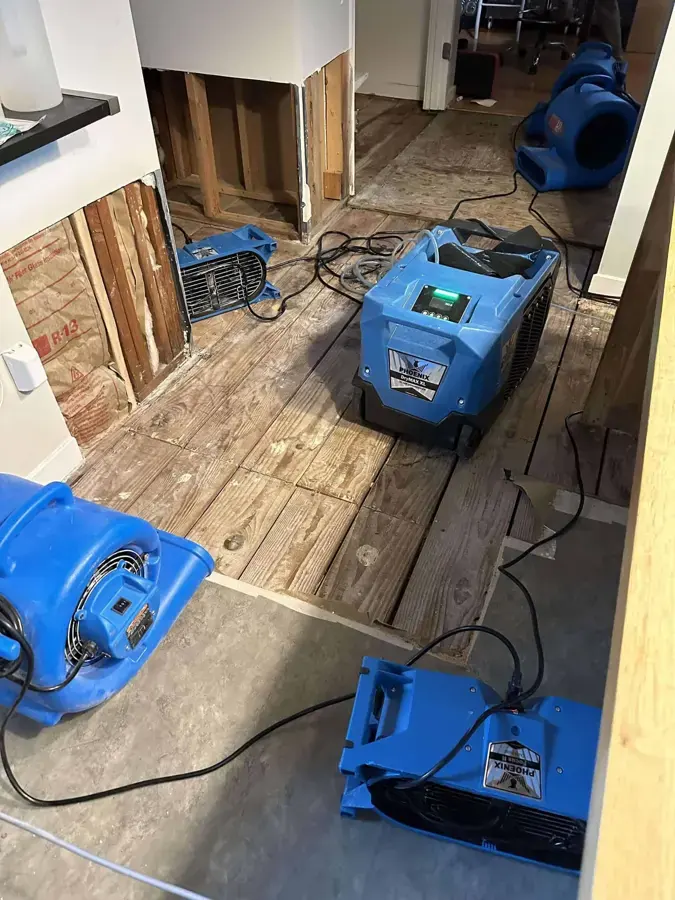
First steps for structural drying and dehumidification in Longview
Keep it closed
Keep windows and doors to the wet area closed so damp outdoor air stays out.
Leave the equipment running
Do not switch off air movers or dehumidifiers between readings.
Keep the heat on
Keep the home heated, since warm air pulls water out of materials faster.
Follow the readings
Ask for the daily readings so you can watch the drying progress.
How structural drying and dehumidification is handled in Longview
Structural drying is the part of a water job nobody sees and everybody pays for. Extraction removes the liquid; structural drying removes the water held inside framing, subfloor, drywall and concrete, and the drying team proves it with readings instead of guesses.
What does structural drying and dehumidification cost in Longview, WA?
Structural drying in Longview typically runs $1,500 to $5,000, depending on the class of loss, the square footage, how many days the equipment runs and whether desiccant units are needed for dense materials.
One or two rooms
- Air movers and an LGR unit
- Moisture map and dry reference
- Daily readings
Several rooms
- Multiple LGR units
- Wall cavity drying
- Psychrometric logs
Class 4 or large loss
- Desiccant dehumidifiers
- Hardwood or concrete drying
- Full claim documentation
Ranges are typical, not a quote: the water category, square footage, material class and how fast drying started move the number most. Run the Longview water damage cost calculator for a closer range.
The structural drying and dehumidification process in Longview
Map and reference
The tech who does the walkthrough maps the wet area and takes dry reference readings from unaffected materials.
Set the equipment
The drying team places air movers and LGR or desiccant dehumidifiers to match the class of loss.
Log every day
The drying team records temperature, humidity and material readings in the psychrometric log daily.
Prove it dry
The drying team removes equipment when materials read within 2 to 4 points of the dry reference.
How the drying team sets up the job
Every setup starts with a moisture map and a dry reference: a reading from the same material in an unaffected part of the home. The goal is to bring wet materials to within 2 to 4 points of that reference.
- Air movers placed to the room's evaporation load, aimed along walls and under cabinets
- LGR dehumidifiers sized to the class of loss and the volume of the space
- Desiccant dehumidifiers for Class 4 losses in hardwood, plaster and concrete
- Plastic containment to shrink the drying zone where it helps
Why Longview air changes the plan
The wet season brings damp outdoor air for months, so opening windows rarely helps a dry-out. The drying team keeps the work area closed and lets the dehumidifiers control the air, checking temperature and humidity inside and out in the daily psychrometric log.
Crawl spaces need their own setup, with air movers along the joist bays and a dehumidifier under the house; the crawl space water removal page covers that work.
Classes of loss and drying time
IICRC S500 sorts losses into four classes by how much water the materials absorbed, and the class sets how much equipment a room needs.
- Class 1: part of a room and low-porosity materials, the fastest to dry
- Class 2: a whole room, with carpet and wall bottoms wet
- Class 3: water from above, with walls soaked high and ceilings wet
- Class 4: hardwood, plaster, concrete and other dense materials that hold water
The EPA advises drying wet building materials within 24 to 48 hours, and Washington State University Extension publishes home and building resources for the state.
Structural drying and dehumidification across Longview and Cowlitz County
Dispatch runs 24/7 for Longview, WA, day or night.
Longview Water Damage Restoration covers ZIP 98632, from the Civic Center, the Old West Side, St. Helens and the Highlands out to Olympic West, Cascade, Columbia Heights, West Longview and Mint Valley, plus the homes around Lake Sacajawea.
Nearby coverage reaches Kelso, Lexington, Castle Rock, Kalama, Woodland, Rainier, OR.
Related water damage services in Longview
Structural Drying and Dehumidification questions in Longview, WA
Water still spreading?
Still wet after the water is gone? The drying team works around the clock.
(888) 509-1696 Call the Longview drying teamWhat does a dry reference mean?
It is a moisture reading from the same kind of material in an unaffected part of the home. Wet materials count as dry when they read within 2 to 4 points of it.
Why not just use fans?
Fans move air but do not remove water from it. Without dehumidifiers, the water evaporating from floors and walls stays in the room and soaks back into other materials.
How long does structural drying take?
A contained Class 1 loss usually dries in three to five days. Class 3 and Class 4 losses with hardwood, plaster or concrete take longer. Readings, not the calendar, decide.
Can I turn the equipment off at night?
No. Drying works around the clock, and switching equipment off lets humidity climb back up and slows the whole job.
What is a psychrometric log?
It is the daily record of temperature, relative humidity and moisture readings inside and outside the drying area. Adjusters use it to see that the drying met the standard.
Is structural drying covered by insurance?
When the water came from a covered event, drying is usually part of the covered mitigation. Coverage depends on your policy, so check with your own insurer. The drying time estimator gives a rough window.
Dry it to a number, not a guess
Water hiding in framing and subfloor keeps causing damage after the floor looks dry. The drying team runs equipment until the readings say dry.
(888) 509-1696Longview structural drying, any hour