Structural Drying and Dehumidification in Castle Rock
Extraction removes the water, and drying removes the rest. The drying team places air movers and dehumidifiers and logs readings until framing, floors and walls reach a dry reference.
(888) 509-1696Request drying service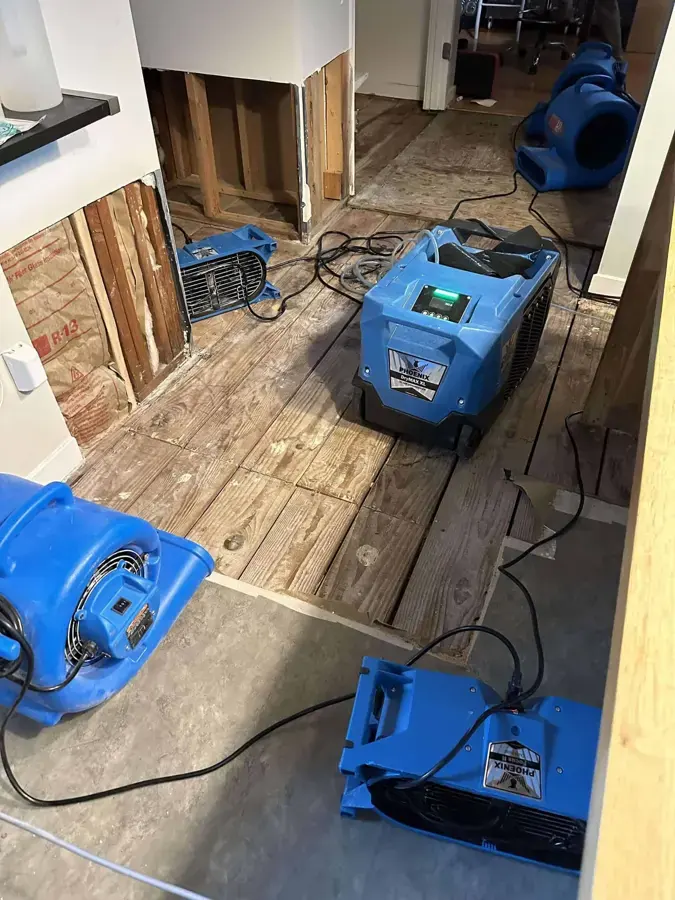
First steps for structural drying and dehumidification in Castle Rock
Map the moisture
Meters and a thermal camera mark every wet surface so equipment goes only where it is needed.
Place the equipment
Air movers go along floors and walls, and dehumidifiers sized for the room run alongside them.
Read and adjust
Readings of moisture, temperature and humidity are taken daily, and equipment is moved as areas dry.
Confirm and remove
When readings match the dry reference, equipment leaves and the logs are filed.
How structural drying and dehumidification is handled in Castle Rock
Wet materials do not dry by themselves in a closed, cool house. Structural drying controls airflow, humidity and temperature so moisture leaves framing, subfloors and drywall in a measured way.
What does structural drying and dehumidification cost in Castle Rock, WA?
One or two rooms run $1,500 to $3,000, several rooms $3,000 to $5,500 and a Class 4 or large loss $5,500 to $12,000, since more rooms and denser materials mean more equipment and more days.
One or two rooms
- Air movers and one dehumidifier
- Moisture map and dry reference
- Daily readings
Several rooms
- Several dehumidifiers
- Wall cavity drying
- Psychrometric logs
Class 4 or large loss
- Desiccant dehumidifiers
- Hardwood or concrete drying
- Complete claim file
Ranges are typical, not a quote: the water category, square footage, material class and how fast drying started move the number most. Run the water damage cost calculator for a closer range.
The structural drying and dehumidification process in Castle Rock
Moisture mapping
The tech scans floors, walls and ceilings with meters and a thermal camera and draws up a map of every wet area.
Equipment setup
Air movers and dehumidifiers are placed to match the map, with desiccant units added for large losses or cold spaces.
Daily monitoring
Moisture, temperature and humidity are recorded each visit, and the setup is adjusted as wet spots dry out.
Dry confirmation
Readings are compared with a dry reference, equipment is removed and the logs are handed over for the claim.
Why drying runs through the wet season
Wet winters and floodplain soils mean drying often follows river or storm water in Castle Rock. Close to 60 inches of precipitation falls in a year, about 80% of it from October through March, and cool damp air slows drying unless a dehumidifier does the work.
How the equipment works together
Air movers push dry air across surfaces and into cavities, and low-grain refrigerant dehumidifiers pull the moisture out of the air so it can take on more. Desiccant units handle large losses and cold spaces where refrigerant units struggle.
- A moisture map shows where water is, so equipment goes where it matters
- Psychrometric readings of temperature and humidity are logged daily
- LGR dehumidifiers are sized to the wet volume of each room
- Hardwood and concrete get their own drying setups
Knowing when it is dry
Drying ends when readings match a dry reference taken from an unaffected part of the same structure, not on a calendar. The crew does not promise a number of days, because the material and the water set the pace.
The logs become part of the claim file. They show the insurer when equipment ran, what readings were taken and why the job was finished, and they back up water extraction done earlier.
Closing up too soon
Sealing walls that still hold moisture traps it. Mold needs about 24 to 48 hours of wet conditions to start, so readings come before any patch or paint.
Structural drying and dehumidification across Castle Rock and nearby communities
Dispatch runs 24/7 for Castle Rock, WA, day or night.
Drying crews work throughout the city, including downtown, the Exit 49 area, Huntington Avenue South, the Buland Drive area and the Four Corners area west of the river, plus ZIP code 98611 and nearby Cowlitz County.
The same service nearby: structural drying and dehumidification in Longview, Kelso, Kalama.
Water damage restoration in Castle Rock · every town covered
Related water damage services in Castle Rock
Structural Drying and Dehumidification questions in Castle Rock, WA
Water still spreading?
Wet framing keeps holding moisture long after the surface looks dry.
(888) 509-1696 Call dispatchHow long does structural drying take?
It depends on the materials, the amount of water and the weather, so no fixed number is promised. Readings decide when it is done, and the crew explains progress at each visit.
Why does the equipment run all the time?
Continuous airflow and dehumidification keep moisture moving out of materials. Turning equipment off early lets damp air settle back into drywall and wood.
What is an LGR dehumidifier?
Low-grain refrigerant units pull moisture from the air even when humidity is already low, which suits drying a wet room in cool weather.
Can hardwood and concrete floors be dried?
Yes, with drying mats, panels and desiccant equipment that draw moisture out slowly. Some hardwood may still cup, and the tech says so after reading the boards.
Will drying raise the electric bill?
Yes, the equipment uses power while it runs. The homeowner can mention this to the insurer, and the crew's logs show how long the equipment stayed on the job.
Is drying needed after the water is extracted?
Yes. Extraction removes liquid water, but framing and subfloor still hold moisture. See storm and flood water cleanup for jobs where river water was involved.
Get the structure drying properly
Dispatch passes the job to a drying crew that maps the moisture, sets equipment to match and keeps daily readings until the structure reaches dry levels.
(888) 509-1696Talk to a drying crew