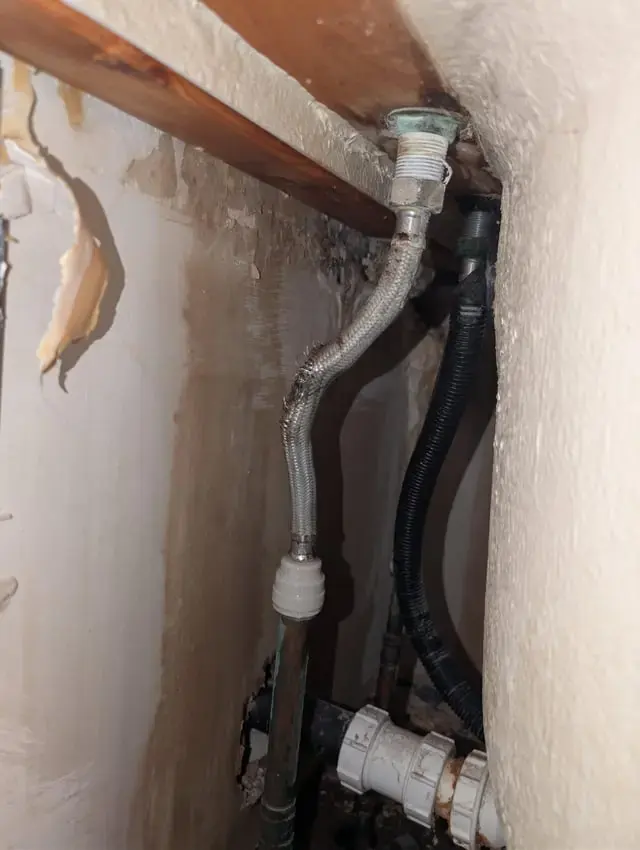
Longview was built as a planned lumber company city, with construction beginning in 1922 and much of it done by 1927. Homes of that age often still carry galvanized supply pipe that corrodes from the inside, so the first sign of trouble can be a damp wall instead of a drip.
Key takeaways
- Galvanized supply pipe in homes from the 1920s corrodes from the inside, so a pinhole or a split can open where nothing shows.
- The first worker housing was 250 small cottages in the Highlands and St. Helens additions, and about 75% of the housing in the two cities of Longview and Kelso combined was built before 1980.
- Shut off the water at the main first, then trace the damp spot on the wall, ceiling or floor.
- A hidden leak wets insulation, framing and subfloor before a stain appears, so the cavity has to be opened and dried.
- Drying is finished when readings fall within 2 to 4 points of a dry reference, not after a fixed number of days.
Why Highlands and St. Helens pipes age from the inside
The Long-Bell company diked and drained the land, then built a city on it. According to HistoryLink, the first worker housing was 250 small cottages in the Highlands and St. Helens additions.
Some of those houses may have been repiped over the decades. Homes of that age often still carry the galvanized steel pipe that was standard when they went up.
How galvanized pipe fails
Galvanized pipe is steel with a zinc coating. Over decades the coating wears away and rust builds on the inside wall of the pipe, narrowing the channel and thinning the metal.
The weak points are threaded joints, elbows and low spots where water sits. A pinhole at one of those spots can spray a fine mist into a wall for days.
- Corrosion works from the inside, so the outside of the pipe can look sound.
- Joints and fittings thin first, then weep or let go under normal pressure.
- A hard freeze can split a pipe that is already weakened, especially in a crawl space, an exterior wall or an unheated garage.
Older housing across both cities
The Consolidated Plan for 2025 to 2029 puts about 75% of the housing in Longview and Kelso combined before 1980.
That is a large pool of homes where the original plumbing, drains and water heaters have had decades to wear.
Signs of a leak inside a wall
A leak behind plaster or drywall rarely announces itself with a puddle. It shows up in small ways first.
None of these signs proves a pipe has failed, but each is a reason to look. Catching a pinhole early can mean one wall opened instead of a whole room.
- Low pressure at one faucet or shower while the rest of the house runs normally.
- Brown or rust colored water when a tap is first opened.
- A damp spot, bubbling paint or a stain on a wall, or on the ceiling below a bathroom.
- A baseboard that swells, a floor that feels soft or a musty smell in one room.
- A water meter that keeps moving when every fixture is off.
The first 24 hours after a pipe lets go
The first move is to stop the flow. Closing the main shutoff stops new water, and opening the lowest faucet drains what is left in the pipes.
Then attention turns to what is already wet. Water follows framing, wiring holes and the bottom of the wall, so it often reaches a ceiling or a room below.
Standing water on a floor needs water extraction before any drying starts, because water that sits keeps soaking deeper into the subfloor.
- Shut off the main, and switch off power to a wet outlet area at the breaker, never with wet hands.
- Photograph the damp area, the shutoff and any visible pipe before anything is moved.
- Lift small items and rugs off wet floors, and keep people out from under a sagging ceiling.
- Call a plumber for the repair and the restoration team for the water. Neither call has to wait for the other.
How the team traces and opens the cavity
The restoration team starts with meter readings and a thermal image to find where wet material ends. Water that traveled along a joist can show up far from the pipe that leaked.
Tracing a split pipe inside walls and ceilings, then opening only the cavities that read wet, is the core of burst pipe cleanup.
Insulation and drywall that absorbed water come out, usually cut above the highest reading so dry material stays in place.
- Moisture readings map wet and dry material before anything is cut.
- Wet insulation is removed because it holds water against the framing.
- Drywall is opened wherever readings stay high, then the exposed studs are cleaned.
- The plumber repairs or replaces the failed pipe once the cavity is open and visible.
Drying framing and subfloor
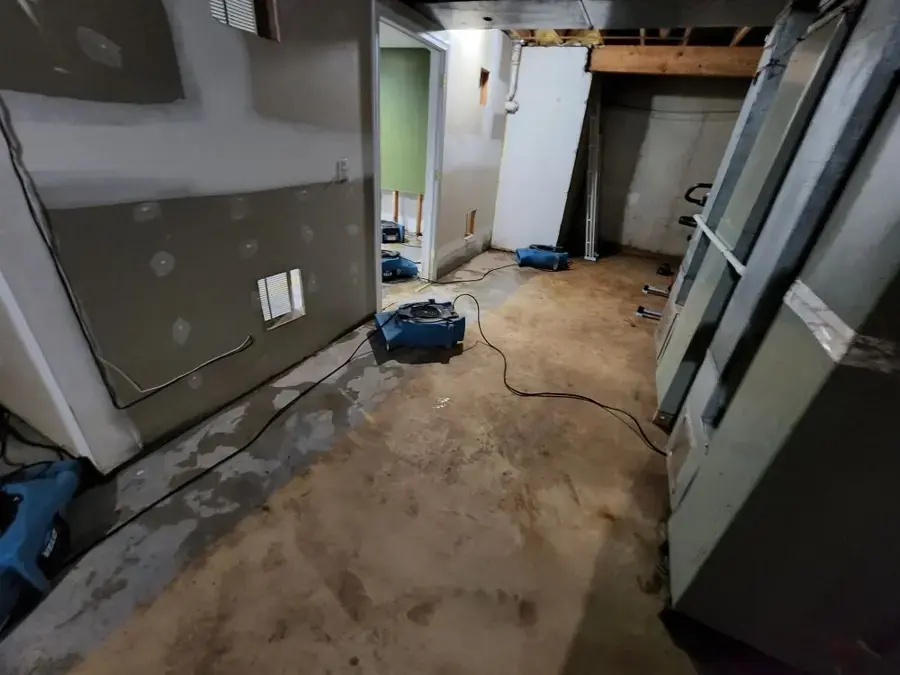
Wood framing and subfloor take up water slowly and release it slowly. Air movers push dry air across the surfaces while LGR dehumidifiers pull moisture out of the air.
Crews check readings on a schedule and adjust the equipment until the framing sits within 2 to 4 points of a dry reference. That target, not a calendar, decides when the equipment leaves.
Materials left damp for 24 to 48 hours invite mold, which is why drying begins before repairs and paint.
The details of structural drying and dehumidification matter most where a pipe ran through an exterior wall or a crawl space.
Replacing old pipe so it does not happen twice
Repairing one failed section does not fix the pipe on either side of it. Galvanized runs that have lost their coating often fail again at the next weak joint.
A plumber can judge whether to replace a single run, one floor of the house or the whole supply system.
- Ask the plumber to look at exposed pipe in the crawl space, garage and exterior walls while the cavity is open.
- Keep the main shutoff clear, and make sure everyone in the house knows where it is.
- Record the date of the repair and photograph the new pipe before the wall is closed.
Questions
Do all Highlands and St. Helens cottages still have galvanized pipe?
Not necessarily. Some may have been repiped. Homes of that age often still carry galvanized supply pipe, but only a look at the pipe shows which kind a given house has.
Can a pipe leak inside a wall without any stain?
Yes. Water can run along framing and collect in insulation for some time before a stain or a soft spot shows, which is why meter readings matter.
Is rust colored tap water a sign of a leak?
Rust colored water points to corrosion in the pipes. It does not prove a leak, but together with low pressure or a damp wall it deserves a plumber's attention.
Should the water be shut off at the main or at the fixture?
At the main when the source is unknown or inside a wall. A fixture shutoff only helps when the leak is at that fixture.
How long does drying take after a supply pipe leak?
It depends on the material and how long it stayed wet. The crew keeps drying until the framing and subfloor read within 2 to 4 points of a dry reference.